What happens to your waste?
You sort it, we handle it!
Waste affects us all and is a shared responsibility.
Recycling right helps to improve neighbourhood cleanliness, minimise disposal costs and conserves natural resources so there’s enough for the future.
Once we’ve collected your waste, here’s what happens next.
Download the full infographic that shows you what happens to your waste below.
Dry mixed recycling
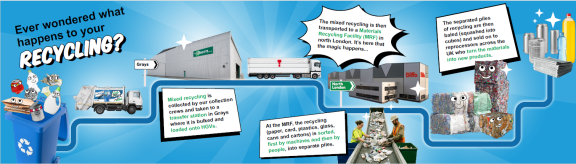
Collection and transport
Mixed recycling is collected by our collection crews and taken to a transfer station in Grays where it is bulked and loaded onto HGVs.
The mixed recycling is then transported to a Materials Recycling Facility (MRF) in north London. This specialised facility is designed to sort mixed recyclable materials into separate streams so they can be processed and turned into new products.
Sorting the recycling
At the MRF, your recycling travels along a series of conveyor belts where different technologies and people check and sort materials into separate piles.
Baling and sending for recycling
Each material is compressed into large bales (squashed cubes) and transported to specialist recycling facilities and sold on to reprocessors across the UK who turn the materials into new products.
For example:
• Paper and cardboard become new packaging, newspapers and tissue products.
• Plastic bottles can become new bottles, clothing fibres, outdoor furniture or construction materials.
• Steel and aluminium cans are melted down and made into new cans, car parts or building materials.
• Glass, where collected, can be crushed and remanufactured into new bottles and jars.
Food waste
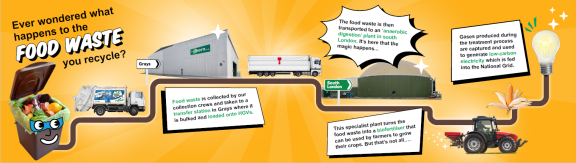
Recycling your food waste is one of the easiest ways to reduce the amount of rubbish sent for disposal while creating valuable renewable resources.
Collection and transport
Once your food waste is collected, it is taken to a transfer station in Gray and then transported to a specialist anaerobic digestion (AD) facility in South London. These facilities are designed to recycle food waste safely and efficiently, turning it into renewable energy and nutrient-rich fertiliser.
Preparing the food waste
When the food waste arrives, it is inspected and any unwanted materials, such as plastic packaging or other contaminants, are removed.
Creating renewable energy
The prepared food waste is placed into large, sealed tanks where naturally occurring microorganisms break it down in the absence of oxygen. This process is called anaerobic digestion.
As the food waste decomposes, it produces biogas, which is rich in methane. These gasses are then captured and used to generate low-carbon electricity which is fed into the National Grid.
Recycled food waste can also produce natural fertiliser for farmland, helping farmers grow crops while reducing the need for manufactured fertilisers.
Garden waste
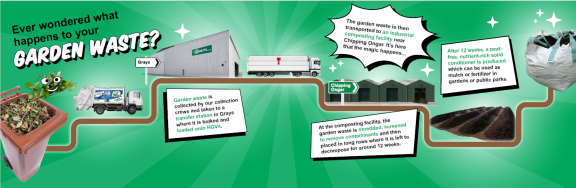
Collection and transport
Garden waste is collected by our collection crews and taken to a transfer station in Grays where it is bulked and loaded onto HGVs. The garden waste is then transported to an industrial composting facility Chipping Ongar. Here, the material is recycled through a carefully managed composting process that creates a high-quality soil improver.
Preparing and composting garden waste
When the garden waste arrives at the composting facility, it is inspected to remove any non-compostable items, such as plastic bags, plant pots or other contaminants.
The garden waste is then shredded and then placed in long rows where it is left to decompose for around 12 weeks. Naturally occurring microorganisms begin to break down the garden waste, generating heat as they work. The material is regularly turned or aerated to maintain the right conditions and ensure the composting process continues efficiently.
Over the 12 weeks, the garden waste gradually decomposes into a dark, crumbly compost.
Producing compost
Once the compost has fully matured, it creates a peat-free, nutrient-rich solid conditioner which can be used as mulch or fertilizer in gardens or public parks.
General waste
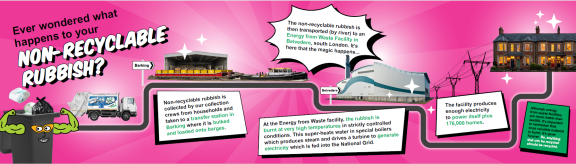
Collection and transport
Non-recyclable rubbish is collected by our collection crews from households and taken to a transfer station in Barking where it is bulked and loaded onto barges.
The non-recyclable rubbish is then transported (by river) to an Energy from Waste Facility in Belvedere, south London.
Sorting and recovery
Although general waste contains items that cannot be recycled through standard household collections, modern facilities use advanced sorting equipment to recover recyclable materials wherever possible.
Materials such as metals, plastics, wood, and other reusable resources may be separated for recycling or further processing. This helps reduce the amount of waste that requires final disposal.
Waste that cannot be removed is burnt at the Energy from Waste facility at very high temperatures in strictly controlled conditions.
This super-heats water in special boilers which produces steam and drives a turbine to generate electricity which is fed into the National Grid.
What Goes to Landfill?
Landfill is now considered the last option for waste disposal. Only waste that cannot be recycled, recovered, or converted into energy is sent to licensed landfill sites.